
Global Heat Budget
Global heat budget. The Sun is the Earth’s source of energy. It ‘powers’ the atmosphere and makes life on Earth possible. This section discusses the following topics:
- Global heat budget: an overview
- Global heat budget
- Global insolation.
Overview
Global heat budget: an overview
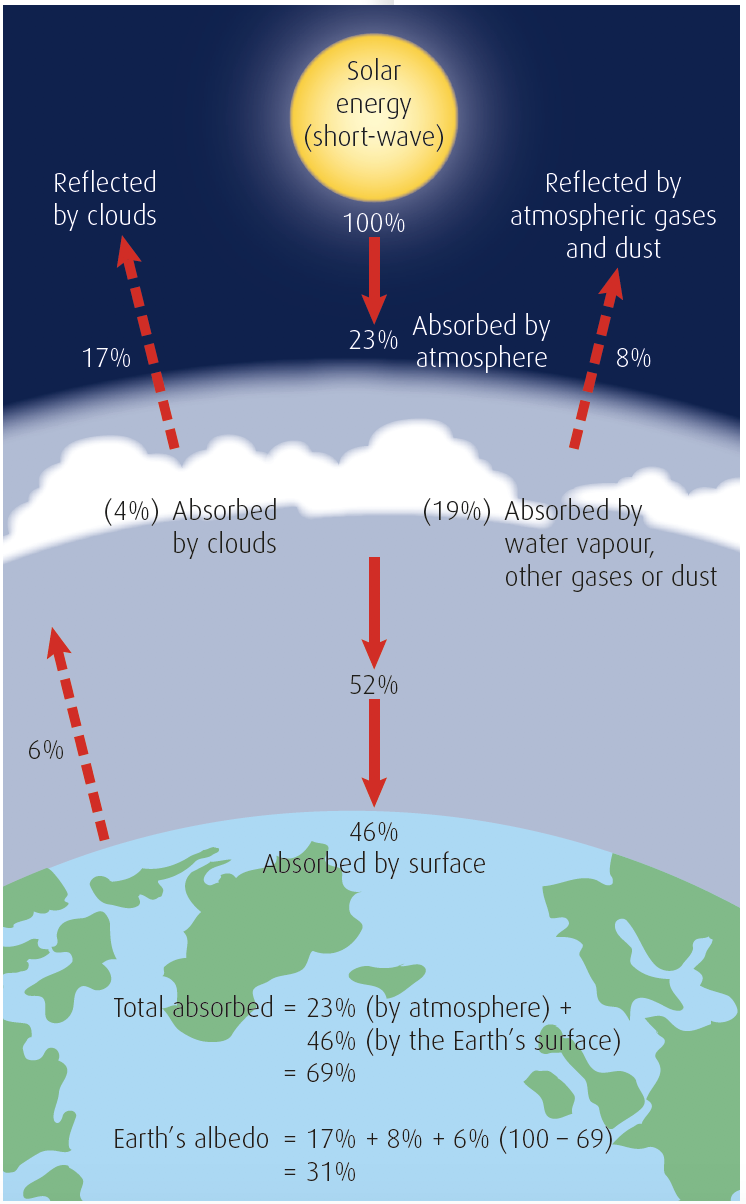
The incoming energy (short-wave energy or insolation) is balanced by the outgoing energy (long-wave or infra-red radiation). The balance between the input and output is the global heat budget.
Energy from the Sun passes through the atmosphere to the Earth’s surface. Some radiation is reflected by clouds (17%), some is scattered by gas particles (8%) and some is reflected by the Earth’s surface (6%). This is known as the albedo. A total of 31% of the incoming solar radiation is lost.
A total of 4% of the incoming radiation is absorbed by clouds and 19% is absorbed by dust, water vapour and gases.
This means that 54% of the incoming radiation is absorbed or reflected, so only 46% reaches the Earth’s surface. About 6% is then reflected by the Earth’s surface as long-wave radiation, so 40% is left to heat the Earth’s atmosphere via gases and water vapour. This is the greenhouse effect, which is necessary for our survival – without it the Earth would be 30–40°C colder.
For more on this topic, have a look at our Higher Geography Study Guide – New Edition, pp. 34–35.
Activities
Learn more about the BBC program Orbit by following this link.
Thoughts
The BBC programme Orbit shows a year in the Earth’s orbit around the Sun and explains this concept really well.
Answer the questions below using Orbit and the effect of latitude diagram.
(a) Describe the areas of surplus and deficit solar radiation on the Earth’s surface.
(b) Explain fully the reasons for these differences.
| (a) | There is a surplus of solar radiation at the Equator and a deficit at the Poles |
| (b) | At the Equator, the Sun’s rays are concentrated on tropical latitudes because the intensity of insolation is greatest where the Sun’s rays strike the ground at right angles
At the Equator, the Sun’s rays have less atmosphere to pass through, so less energy is lost through absorption and reflection The angle of the Sun in the sky decreases towards the Poles and, because of the Earth’s curvature, the heat energy is spread over a much larger area, reducing the intensity of the solar radiation The albedo is different between the tropics and the Poles – darker forest surfaces absorb radiation, whereas ice-covered surfaces reflect radiation Between the tropics the rays from the noon-day Sun are high in the sky throughout the year, focusing energy in this area There is zero solar insolation at the winter solstice at the Poles because it is dark during their winter – the Sun shines all through the year at equatorial latitudes |