Analogue Control Systems
This section covers the following topics:
- Two-state control
- Proportional control
- Types of feedback in a system
Overview
Two-state control
Many control systems have to process analogue signals such as heat, light and movement. Therefore analogue closed-loop control systems require an analogue processing device such as the operational amplifier (‘Op Amp’). This is a component we will delve further into within the ‘Electronics and Control’ chapter.
Proportional control
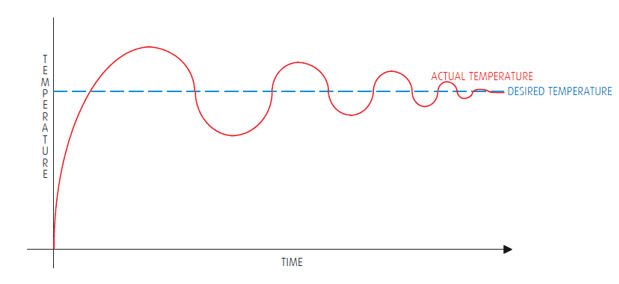
Proportional control is another way of controlling the output, without having the same negative traits. This is a system that reduces the error proportionally – if the error is large, it sends a large negative signal to fix the problem. If the error is small, it sends a small signal. This allows the desired output to eventually be reached.
For more on this topic, have a look at our Higher Engineering Science Study Guide, pp. 10–11.
Quizzes
Click a link below to take a topic quiz:
Thoughts
An outdoor swimming pool uses a two-state closed-loop control system to regulate the water temperature.
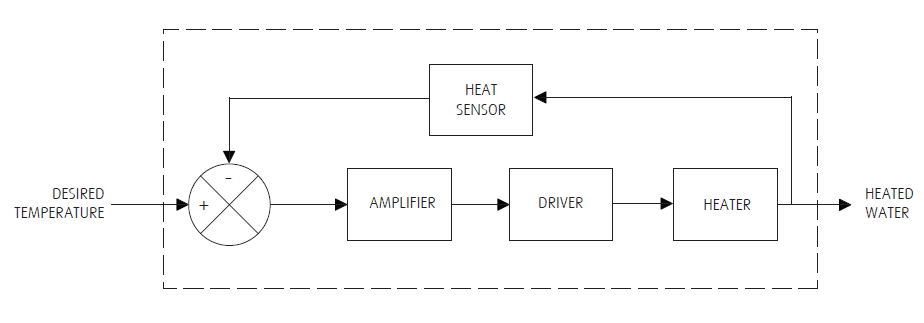
Comparator
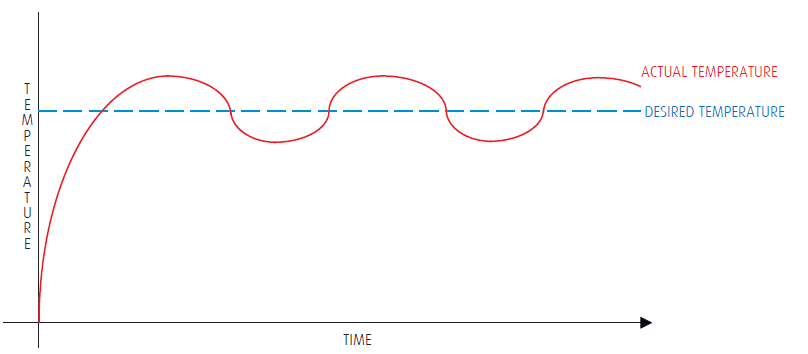
- The actual temperature is compared to the desired temperature, with the actual temperature rising until it becomes greater than the desired one.
- The error detector will attempt to correct the difference between them by amplifying the signal until it returns the actual output to match the desired setting.
- Each time the system attempts to correct itself, it ‘overshoots’ slightly before being corrected again (lag).
- On each cycle of overshooting and correction, the lag gradually reduces.