Choral Fugues
This section covers the topic of choral fugues.
Overview
Choral fugues
Many composers have incorporated fugues into choral works. He trusted in God from Handel’s oratorio Messiah is an example of a fugue for four voices. It starts with a subject, sung by the basses in a minor key, which has four beats in the bar.

The tenors then enter with the answer in the dominant key, followed by the subject sung by the altos in the tonic key, and then the answer sung by the sopranos in the dominant key. The music continues with a contrapuntal texture and prominent use of sequences. At the very end the music suddenly slows down, the texture becomes homophonic, and it draws to a close with three staccato chords, a suspension and a perfect cadence.
The Kyrie from Mozart’s Requiem Mass is an example of a double fugue as it has two subjects. The first subject is introduced by the basses with the words ‘Kyrie eleison’, while the second subject is introduced by the sopranos with the words ‘Christe eleison’. These two subjects always appear as a pair throughout the movement.
For more on this topic, have a look at our Advanced Higher Music Study Guide, pp. 34–35.
Related Videos
Listen to Handel’s He trusted in God from Messiah.
Listen to Mozart’s Kyrie from the Requiem Mass.
Listen to Cool.
Listen to Fugue for Tinhorns.
Quizzes
Click a link below to take a topic quiz:
Thoughts
Composing a fugue
Experiment with some techniques associated with fugue, and consider incorporating them into your own composition. The guide below takes you through a step-by-step approach to composing a simple exposition with three parts (or voices).
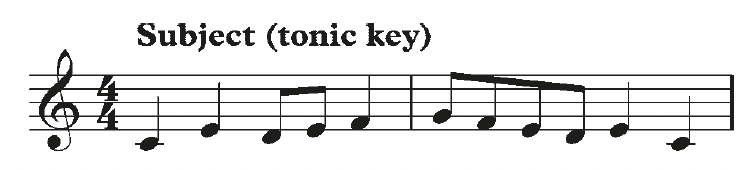
1. Create a short subject which could be harmonised easily. The example given is two bars long, in the key of C major, and uses just five notes.
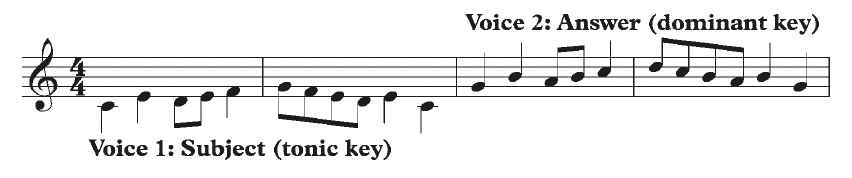
2. Create the answer by transposing the subject into a new key. In this example the subject is in the alto voice and is imitated in the dominant key (G major) by the soprano voice.
3. Create a countersubject in the alto voice that will fit along with the answer in the soprano voice. Using intervals such as 3rds and 6ths will help the harmony to sound full. Also, using some contrary motion will make the individual lines more interesting and independent.
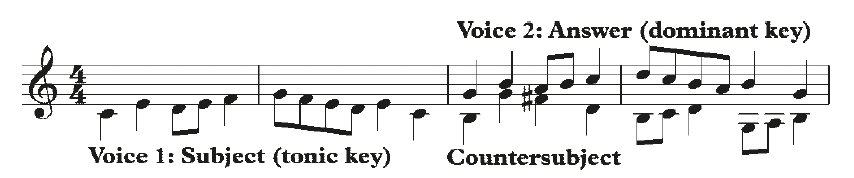
4. Extend the answer in the soprano voice by adding the countersubject in the dominant key. In this example the countersubject has been amended slightly to ensure a smooth transition back to the tonic key.
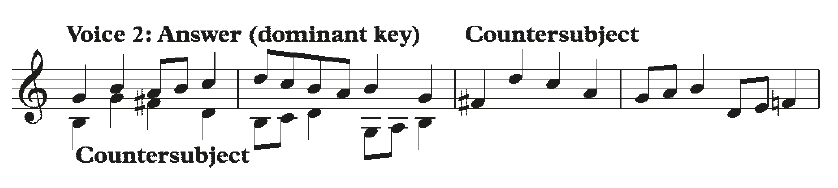
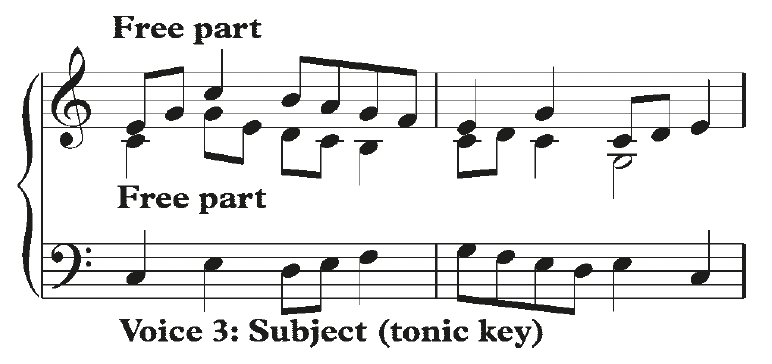
5. Create a free part in the alto voice to fit along with the countersubject in the soprano voice. Again, using intervals such as 3rds and 6ths will help the harmony to sound full.
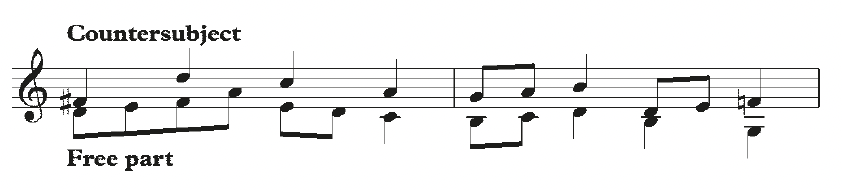
6. Introduce the final entry of the subject in the bass part.
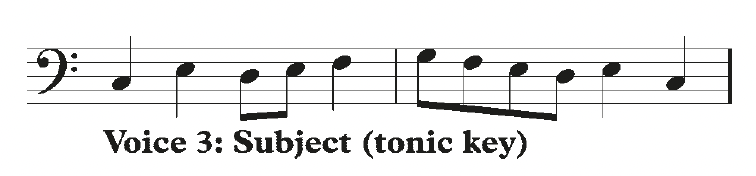
7. Create two free parts for the soprano and alto voices, to fit above the subject in the bass. Putting this together gives you an example of an exposition of a fugue.