Recurrence Relations
Algebra. Recurrence relations deal with situations where the current value depends on a previous value, and future values depend on the current value. Real-life examples of this include the depreciation in value of cars, removal of pollution by the use of a detergent or the actions of the sea, the spread of disease in a population, the growth of cells in a culture and the control of disease by the use of antibiotics. This section covers:
- Formulae for sequences
- Limits
- More on limits
- Problems in context
Overview
Formulae for sequences
A recurrence relation is a rule, or formula, given for working out any term in a sequence if you know the one before. For example, with un standing for the nth term in a sequence:
un + 1 = un + 6 (a recurrence relation)
and
u1 = −11 (the first term)
generates the infinite sequence −11, −5, 1, 7, 13, 19, 25, …
The recurrence relation

is given by the formula un + 1 = 2un + 3
Problems in context
Examples from real life include growth and decay, bank loans, pollution levels, inflation, policies for culling animals, removing pests and monitoring drug levels in patients. They normally involve changes over time. For example, a patient may be given a dose of antibiotics every four hours, or interest may be added to a loan every month. Use a ‘0’ suffix for the amount at the start (A0 rather than A1) because then A4 will mean the value after four of these time intervals. This avoids confusion!
For more on this topic, have a look at our CfE Higher Mathematics Study Guide, pp. 32–35.
Activities
Find out more about sequences and recurrences relations involved in problem solving such as the Towers of Hanoi at examsolutions.net and via this utdallas.edu PDF.
To find out more about recurrence relations and limits, visit mathsmutt.co.uk.
Quizzes
Click a link below to take a topic quiz:
Thoughts
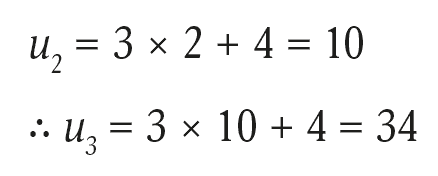
1. A sequence is defined by un+1 = 3un + 4 with u1 = 2. What is the value of u3? (2)
- (a) 34
- (b) 21
- (c) 18
- (d) 13
2. The terms of a sequence satisfy un + 1 = kun + 5. Find the value of k which produces a sequence with a limit of 4. (2)
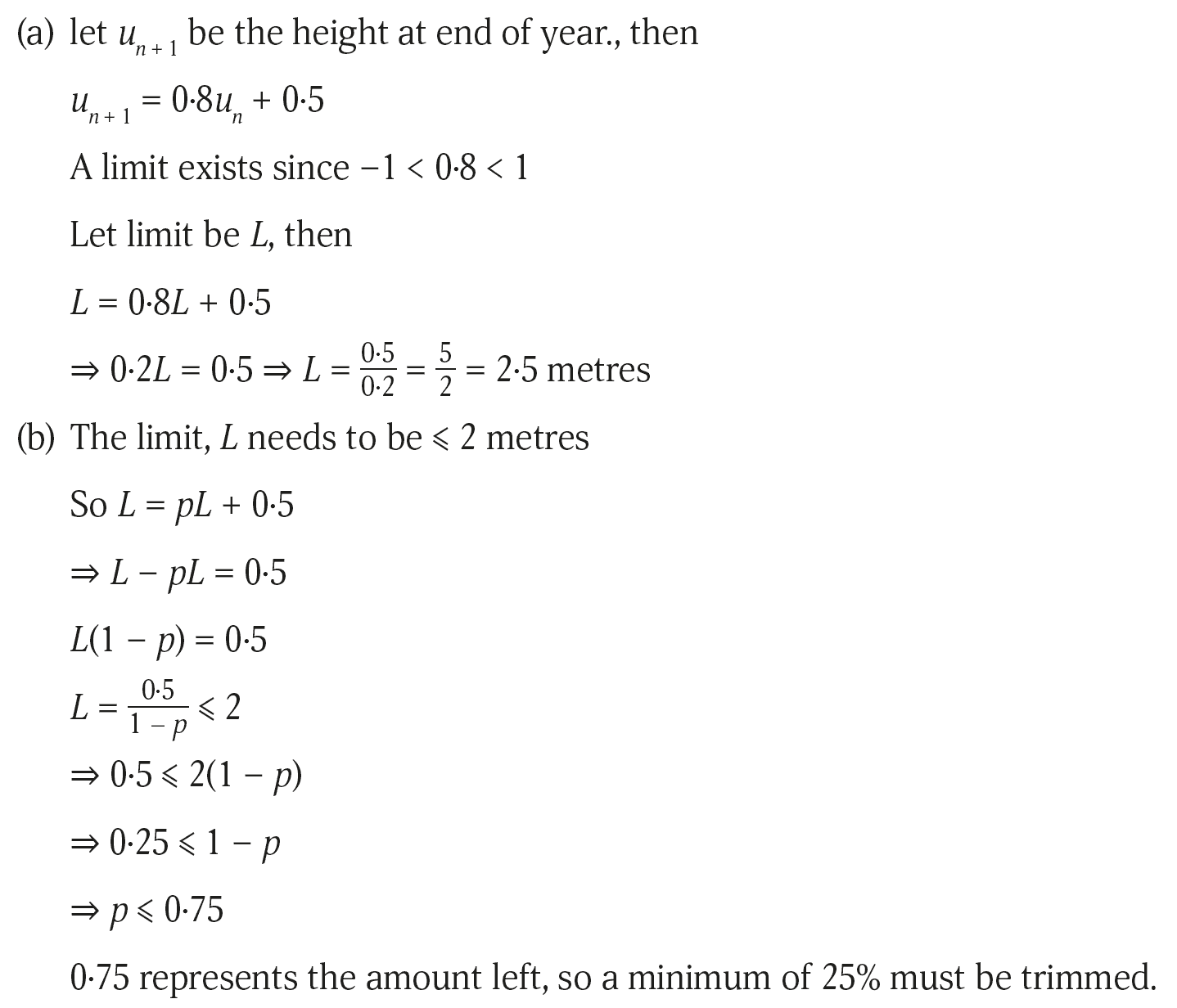
3. A man decides to plant a number of fast-growing trees as a boundary between his property and the property of his next door neighbour. He has been warned, however, by the local garden centre that, during any year, the trees are expected to increase in height by 0.5 metres. In response to this warning he decides to trim 20% off the height of the trees at the start of any year.
- (a) If he adopts the 20% pruning policy, to what height will he expect the trees to grow in the long run? (3)
- (b) His neighbour is concerned that the trees are growing at an alarming rate and wants assurances that the trees will grow no taller than 2 metres. What is the minimum percentage that the trees will need to be trimmed each year so as to meet this condition? (3)
A