
Electronic Configurations and Oxidation States of Transition Metals
Overview
Electronic Configurations and Oxidation States of Transition Metals. This section covers the following topics:
- Electronic configurations
- Oxidation states.
Electronic configurations
The d block transition metals are metals with an incomplete d subshell in at least one of their ions. We consider the first row of the transition metals as being from scandium to zinc and the second row from yttrium to cadmium. Platinum and gold are in the third row. Most of the common metals in everyday use are transition metals.
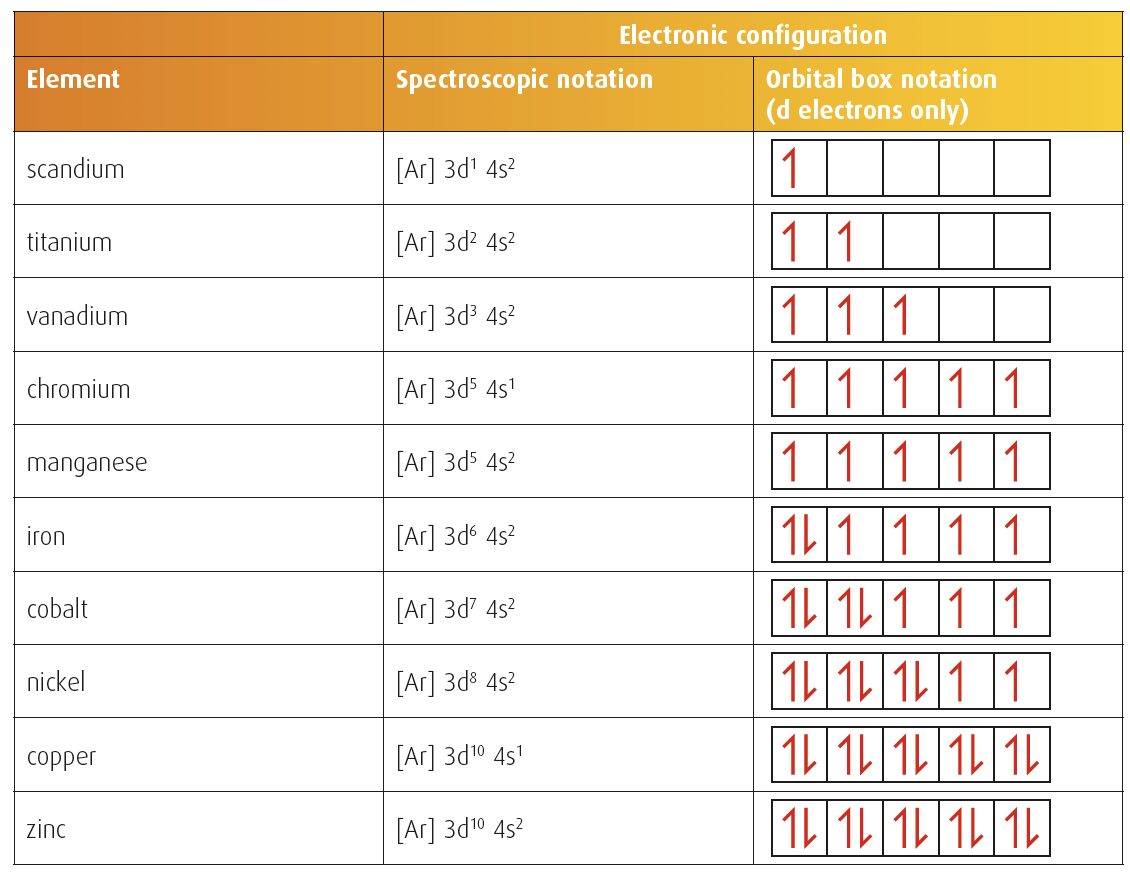
When we consider the electronic configurations of the elements from scandium to zinc, we are usually filling the 3d subshell according to the aufbau principle. Once again, the electronic configuration has to fit in with the electron arrangement given in the SQA Data Booklet.
The table shows the electronic configuration in spectroscopic and orbital box notation for the elements from scandium to zinc.
For more on this topic, have a look at our Advanced Higher Chemistry New Edition Study Guide, pp. 20–21.
Tests
- Click a link below to take a topic test:
- Electronic Configurations and Oxidation States of Transition Metals
Related Videos
This video will help with revision of oxidation numbers:
This video shows an experiment covering the different oxidation states of vanadium with their corresponding colours:
Activities
Thoughts
- 1 The d block transition metals are metals with an incomplete d subshell in at least one of their ions. Try to explain why Sc and Zn are often considered not to be transition metals.
- 2 Consider the electronic configurations of the Fe2+ and Fe3+ ions in both spectroscopic and orbital box notations. Use these notations to explain why Fe(III) compounds are more stable than Fe(II) compounds.
- 3 Work out the oxidation number of Cr in Cr2O72- (aq) and explain why acidified dichromate is a good oxidising agent.