Functions: Exponentials and Logarithmic Functions
Algebra. This section looks at:
- Exponentials and logarithmic functions
- Using logarithms to establish relationships of the form y = kxn and y = abx
- Exponential growth and decay
Overview
Exponential growth and decay
Real-life problems such as the spread of diseases, the treatment of pollution, radioactive decay and financial investments can be modelled and solved by exponential and logarithmic functions.
EXAMPLE
The amount At micrograms, of a radioactive substance remaining after t years decreases according to the formula At = A0e−0•003t where A0 is the amount present initially.
(a) If 250 micrograms are left after 500 years, how many micrograms were present initially?
(b) Find the half-life of the substance.
SOLUTION
(a) We are told that t = 500 and A500 = 250,
So A500 = A0e−0•003 × 500 = 250
⇒ A0 = 250e−1∙5
Using a calculator gives A0 = 1120 micrograms.
(b) The half-life is the time it takes for the amount of radioactive substance to fall to half of its original amount, so At = 12
A0.
Using At = A0e−0•003t, we get 12
A0 = A0e−0•003t; so 12
= e−0•003t.
Taking logs of both sides gives loge12
= logee−0•003t ⇒ loge 12
= −0•003tlogee
⇒ loge12
= −0•003t and t = loge0•5/−0•003 = 231
The half-life is 231 years.
For more on this topic, have a look at our CfE Higher Mathematics Study Guide, pp. 28–29.
Activities
For more on logarithms, visit mathsisfun.com and themathpage.com.
Thoughts
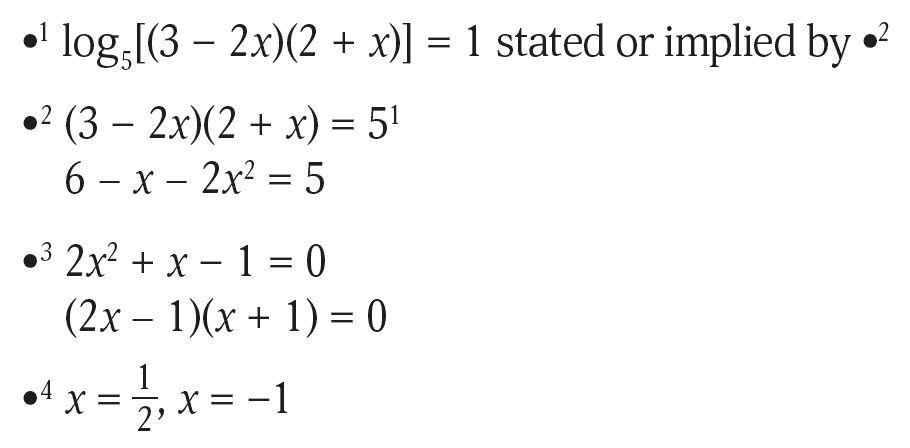
1. Solve the equation log5(3 – 2x) + log5(2 + x) = 1, where x is a real number. (4)